

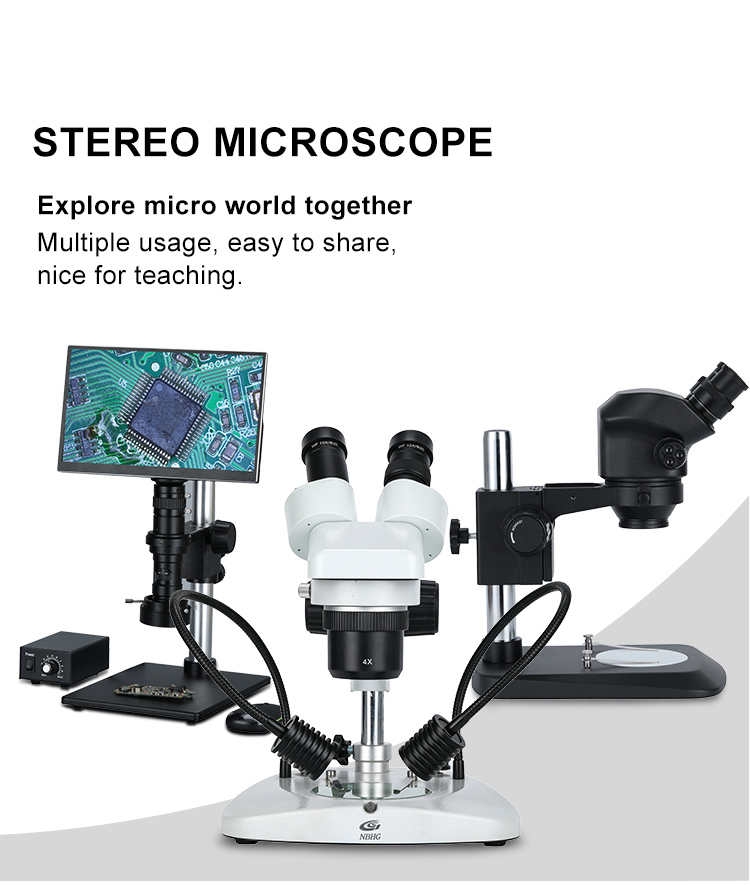
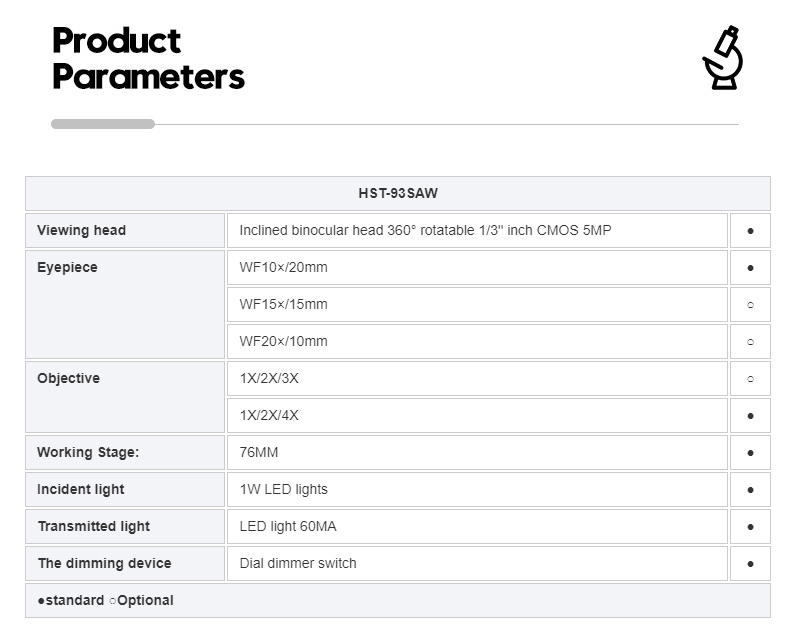
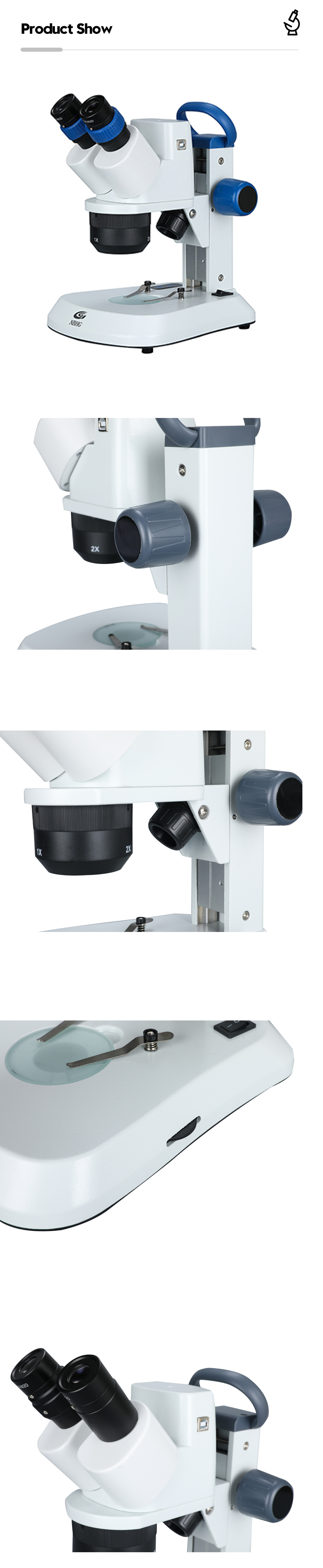
Binocular Head Microscope with Dial Dimmer Switch for Clear Laboratory and Precision Inspection
When I talk with customers about choosing a microscope, I usually try not to start with a long list of specifications. I start with the sample.
What are you looking at? How small is it? Does it have a shiny surface? Do you need both hands to work on it? Will one person use the microscope all day, or will several operators share the same workstation?
These questions often tell us more than a single magnification number.
Our Binocular Head Microscope with Dial Dimmer Switch is designed for practical observation of Small Parts, surface details, components, and solid samples. The binocular head allows the operator to observe through both eyes, while the dial dimmer switch provides a simple way to adjust the illumination during daily work.
I like the dial control because it is straightforward. There is no complicated menu to learn. When the sample is too dark, the operator can increase the light. When the surface is highly reflective, the brightness can be reduced. The goal is simply to create a viewing condition that makes the sample easier to inspect.
A Binocular Microscope is especially useful when the operator needs a natural two-eye view. In stereo microscopy, separate optical paths provide the left and right eyes with slightly different views, helping the brain understand the three-dimensional shape of the sample. This is one reason Stereo Microscopes are widely used for inspection, assembly, electronics, and other work involving solid objects.
Our company, Ningbo Huaguang Precision Instrument Co., Ltd., is located in Haishu District, Ningbo. We mainly produce educational microscopes, Industrial Inspection microscopes, professional Jewelry Inspection microscopes, optical components, and precision injection molding products.
Our products are exported to more than 20 countries and regions, including America, Brazil, Germany, the Netherlands, and Japan. We work with customers in different industries, so we understand that a Microscope Used for jewelry inspection may have different requirements from one used for electronics assembly or laboratory teaching.
For us, this product is not about putting as many features as possible into one microscope. It is about providing a useful combination of binocular observation, practical focusing, stable mechanical operation, and simple illumination control.
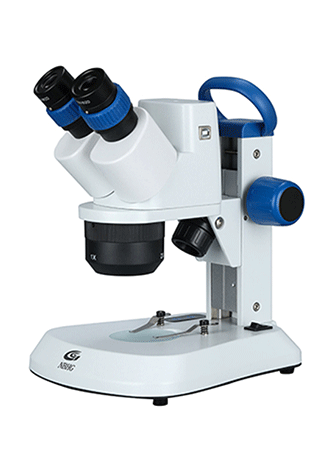
The basic idea behind binocular observation is quite easy to understand.
When you look at an object with both eyes, your left eye and right eye receive slightly different views. Your brain combines the information and gives you a sense of depth.
A binocular microscope uses this natural process. Its optical system provides separate viewing paths so the operator can observe the sample with both eyes.
This becomes useful when the object has height, curves, edges, holes, grooves, or other three-dimensional features.
For example, imagine that I am checking a small mechanical component. I may need to see whether an edge has been machined correctly, whether a groove is clean, or whether a small raised feature is in the correct position. Looking at the component through a binocular microscope gives me more useful spatial information than simply looking at a flat picture.
The same principle applies to electronics. A PCB is not completely flat. Components sit at different heights, connectors extend from the board, and solder joints have their own shapes. A binocular microscope gives the operator a more natural view while working around these parts.
Jewelry is another good example. A ring, setting, gemstone, or engraved surface contains curves and height differences. The operator needs to understand the shape of the object, not just see a magnified photograph.
| Viewing System | Basic Observation Method | Typical Practical Use |
|---|---|---|
| Binocular microscope | Observation through both eyes | Detailed inspection of solid parts and three-dimensional objects |
| Monocular microscope | Observation through one eye | Routine observation where one-eye viewing is acceptable |
| Digital Microscope | Image displayed electronically | Inspection, recording, sharing, and group viewing |
Source: General comparison based on published stereo microscopy and microscope selection guidance from Leica Microsystems. This is a general technical comparison, not a comparison between specific commercial models.
Of course, the exact performance of a microscope depends on its complete optical configuration. The binocular head is one part of the system, and the objective, eyepieces, illumination, focusing mechanism, stand, and accessories all influence the final result.
For occasional observation, almost any workable viewing arrangement may seem acceptable. But when a technician spends hours at a microscope, comfort becomes much more important.
Leica Microsystems specifically notes that microscope users who spend long periods at the eyepieces can experience physical strain when the viewing position is not suitable. It recommends adapting the microscope height and viewing position to the individual operator.
This is why we pay attention not only to image quality but also to how the microscope feels during actual use.
The dial dimmer switch is one of the most practical features of this microscope.
At first glance, a dimmer may seem like a small detail. In actual inspection work, however, illumination can have a big effect on what the operator sees.
A microscope does not create useful information from magnification alone. If the sample is poorly illuminated, increasing magnification will not automatically solve the problem.
A dark component may need more light. A shiny metal surface may become uncomfortable to view when the light is too strong. A textured surface may show more detail at one brightness level than another.
This is why illumination should be considered together with the optical system and the sample.
Leica's guidance on selecting a stereo microscope explains that illumination can strongly affect what details are visible. It notes that suitable illumination should provide even lighting, useful contrast, and appropriate color rendering for the application.
Our dial dimmer gives the operator direct control of illumination intensity. Instead of stopping the inspection to change a complicated setting, the user can make a quick adjustment by turning the control.
Imagine a technician checking dozens or hundreds of components during a shift.
The operator does not want to spend time navigating settings every time the sample changes. A physical dial is easy to understand. Turn it one way to increase brightness, turn it the other way to reduce it, and find the level that works for the current sample.
That is the kind of small practical detail that can make equipment easier to live with.
| Sample Condition | Possible Lighting Issue | Dial Dimmer Response |
|---|---|---|
| Dark-colored component | Fine surface details may be difficult to distinguish | Increase illumination as needed |
| Highly reflective metal | Strong highlights may reduce comfortable viewing | Reduce illumination when appropriate |
| Mixed-color sample | Different areas may respond differently to light | Adjust brightness to find a practical viewing level |
| Long inspection session | Excessive brightness may make viewing uncomfortable | Set a more comfortable illumination level |
Source: General illumination principles based on Leica Microsystems' published stereo microscope selection guidance. Actual illumination performance depends on the complete microscope and lighting configuration.
I would not say that brighter is always better. In many inspection jobs, the right amount of light is more useful than the maximum amount of light.
When I evaluate a microscope for production use, I look at the whole working experience.
The image needs to be clear. The focusing mechanism needs to respond smoothly. The microscope needs to stay stable. The operator needs to see the sample without constantly adjusting their body position.
These things sound ordinary, but they become important after several hours of repeated inspection.
The binocular head is designed for two-eye observation. It supports a more natural view of solid objects and can be useful when the operator needs to judge depth and shape.
Stable focusing is important for repeated inspection. The operator should be able to bring the required area into focus without unnecessary movement or instability.
For small components, even a slight unwanted movement can make an inspection task frustrating. That is why mechanical assembly and adjustment are important parts of our production process.
The dial dimmer provides a direct way to change the illumination. It is especially useful when the same workstation is used to inspect different types of samples.
Microscope ergonomics are not just about comfort for its own sake. A stable and comfortable viewing position can help the operator maintain a consistent working posture.
Leica Microsystems recommends adjusting the microscope height, viewing height, and viewing angle to the individual operator, especially when a microscope is used for extended periods or shared by multiple users.
For electronics repair, assembly, jewelry inspection, and precision work, the operator often needs to use tools while looking through the microscope.
That means the microscope should not only provide an enlarged image. The mechanical configuration should leave useful space around the sample where the application requires it.
Industrial stereo microscope systems are commonly designed around this kind of hands-on work. Leica, for example, describes stereo microscope use in PCB inspection, soldering, rework, assembly, and medical component manufacturing.
One of the reasons I like binocular microscopes is their flexibility. The same basic optical concept can support many different jobs.
Electronics manufacturing is a natural application for this type of microscope.
Operators may inspect solder joints, component placement, connectors, wires, PCB surfaces, and small assembly details. A binocular view makes the physical shape of the components easier to understand.
The adjustable illumination is also useful because PCBs often contain a mixture of dark, bright, reflective, and textured surfaces.
For repair work, the microscope can also be used while the technician handles a soldering tool or another small instrument, provided the selected configuration offers enough working space.
Jewelry inspection requires careful attention to small surface details.
Operators may check polishing marks, stone settings, engraving, edges, small scratches, or assembly details. Because jewelry surfaces are often reflective, the ability to adjust the illumination can be especially helpful.
Small mechanical components often contain features that are difficult to see with the naked eye.
A binocular microscope can be used to inspect grooves, edges, holes, threads, machined surfaces, and assembly positions.
It can be placed at an incoming inspection station, production inspection station, repair bench, or final quality control area.
Small medical device components may require detailed visual inspection during assembly and quality control.
The microscope can support observation of small parts and surfaces, although regulated medical applications should always be matched with the customer's specific documentation and certification requirements.
A binocular microscope is also useful in schools and teaching laboratories.
Students can observe insects, plant material, rocks, small mechanical parts, and other solid objects. The two-eye viewing system provides a more natural way to understand three-dimensional shapes.
Laboratories often need flexible observation tools rather than one microscope designed for only one sample.
A binocular microscope can support sample sorting, preparation, surface observation, material inspection, and other research tasks involving relatively large or three-dimensional samples.
Repair technicians often need both hands. They may be holding a tool in one hand while stabilizing a component with the other.
A microscope that provides a clear enlarged view while leaving space around the sample can make these tasks much easier.
Quality control is another important application.
A microscope can help inspectors identify scratches, burrs, surface marks, assembly problems, contamination, incorrect positioning, and other visible issues.
It does not replace the company's complete quality system, but it can be a useful inspection instrument inside that system.
Customers sometimes ask me whether they should buy a binocular microscope or a digital microscope.
There is no single answer for every application. The right choice depends on how the microscope will be used.
A binocular microscope is especially useful when direct optical observation and natural depth perception are important. A digital microscope can be attractive when image recording, display sharing, measurement, or group viewing is a major part of the workflow.
| Factor | Binocular Microscope | Digital Microscope | Typical Consideration |
|---|---|---|---|
| Viewing method | Direct optical viewing through both eyes | Electronic display | Depends on operator preference and workflow |
| Depth perception | Natural binocular observation | Depends on imaging system and display method | Important for three-dimensional inspection |
| Image recording | Requires suitable camera accessories if needed | Commonly integrated into the digital workflow | Digital systems can be convenient for documentation |
| Hands-on inspection | Well suited to direct component handling | Also possible depending on stand and working distance | Check the actual workspace before purchase |
| Group viewing | Normally one or two direct viewers depending on configuration | Display can support multiple viewers | Useful in training or demonstration environments |
Source: General comparison based on published microscopy system principles and application guidance. Specific performance varies considerably between microscope models. Leica's industrial stereo microscope materials describe direct stereo observation for electronics, medical devices, and hands-on inspection.
For customers who mainly need direct visual inspection, a binocular microscope remains a straightforward choice.
If the workflow is heavily dependent on images, measurements, recording, or sharing a view with several people, we may discuss a digital or camera-equipped configuration instead.
In other words, I would rather match the microscope to the job than push one type of product into every application.
At Ningbo Huaguang Precision Instrument Co., Ltd., we treat the microscope as a complete product. Optical parts, mechanical parts, illumination, accessories, packaging, and documentation all have to come together correctly.
Our manufacturing background covers educational microscopes, industrial inspection microscopes, professional jewelry inspection microscopes, optical components, and precision injection molding.
Our products are exported to more than 20 countries and regions. International orders require attention not only to the microscope itself but also to packing, transportation, documents, and communication.
The production cycle depends on the microscope model, optical configuration, accessories, order quantity, and customization requirements.
For standard configurations, production can usually be arranged more directly. Customized orders may require additional confirmation and preparation before manufacturing.
I prefer to confirm the exact configuration before giving a production schedule because different combinations of optics and accessories can change the preparation time.
Our general process includes component preparation, mechanical assembly, optical assembly, focusing adjustment, illumination checking, accessory confirmation, appearance inspection, and final packaging.
The objective is not simply to make the microscope look complete. We want the operator to receive a product that works as expected in actual use.
Before delivery, we check optical performance, focusing, mechanical operation, accessories, appearance, and overall assembly quality.
We also confirm that the delivered configuration matches the agreed order.
A precision microscope needs protection during international transportation.
We use cushioning and dust-proof materials, individual boxes, and reinforced export cartons. The exact packaging method can be adjusted according to the product configuration, quantity, and shipping requirements.
Payment is arranged according to the agreed order terms, commonly with a deposit and balance before shipment.
Transportation can be handled through air freight, sea freight, express delivery, or another suitable logistics method depending on the destination, quantity, and delivery requirements.
We provide the agreed microscope configuration, accessories, user documents, and applicable inspection or certification documents with the shipment.
When buying a microscope for business use, I think the supplier matters almost as much as the product.
A microscope may look good on a product page, but what happens when you need a different accessory? What if your sample requires a different illumination arrangement? What if you need several units packed for export? What if the application is different from the standard configuration?
These are the questions that become important after the initial purchase decision.
At Ningbo Huaguang Precision Instrument Co., Ltd., our business covers several areas of precision optical products. We have experience with educational microscopy, industrial inspection, jewelry inspection, optical components, and precision injection molding.
We also work with overseas customers in different markets. Our products have been exported to America, Brazil, Germany, the Netherlands, Japan, and other countries and regions.
Our approach is to understand the application before confirming the configuration.
If a customer tells me, “I need a microscope for PCB inspection,” that is a useful starting point, but it is not enough to choose the complete system. I also want to know the approximate PCB size, the smallest detail to inspect, whether rework will be performed under the microscope, how long the microscope will be used each day, and what type of lighting is needed.
The same applies to jewelry, mechanical parts, laboratory samples, and educational use.
Our company has stated ISO9001 quality management system certification, and applicable products have been stated as CE and RoHS certified. Certification should always be checked against the specific product configuration and current documentation before purchase.
Our company credo is “Nothing is perfect only better and better.”
For us, that means continuing to improve design, manufacturing, product quality, inspection, communication, and after-sales service.
We do not believe that a microscope should be complicated just to appear advanced. If a simple mechanical control works well, it should be simple. If a customer needs a customized configuration, we should discuss the actual application instead of guessing.
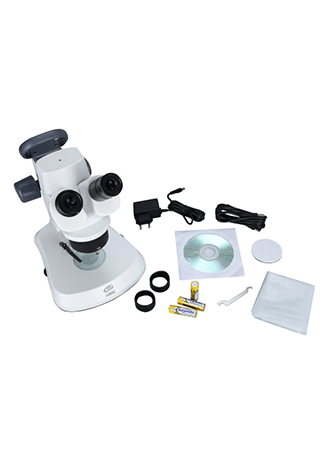
A binocular head microscope has two optical viewing paths and allows the operator to observe through both eyes. This can provide a natural viewing experience and useful depth perception when examining solid and three-dimensional objects.
The dial dimmer switch is used to adjust the illumination intensity. The operator can increase or reduce the light according to the sample and observation conditions.
Different materials reflect and absorb light differently. A dark sample may need more illumination, while a shiny metal surface may become difficult to inspect under excessive brightness. Adjustable illumination gives the operator more control over the viewing condition. Leica also identifies illumination as an important factor when selecting a stereo microscope.
Yes. Binocular Stereo Microscopes are commonly used for electronics inspection, assembly, soldering, and rework. The exact suitability depends on the microscope configuration, sample size, required detail, and working space. Leica describes Stereo Microscope Applications that include PCB inspection and rework.
Yes. Jewelry inspection is well suited to binocular observation because jewelry contains three-dimensional surfaces, small edges, settings, engraving, and reflective materials. Adjustable illumination can also help the operator find a more useful viewing condition.
It can be, provided the microscope and workstation are correctly set up. Viewing height, viewing angle, chair height, and working position all affect comfort. Leica recommends adapting microscope ergonomics to the individual user, particularly during extended work.
No. Magnification is only one part of microscope performance. Field of view, working distance, resolution, depth of field, illumination, and the size of the sample also matter. The correct configuration depends on what the operator actually needs to inspect.
Working distance is the distance between the objective and the sample when the image is properly focused. It matters when the operator needs space to handle the sample or use tools beneath the microscope.
A binocular microscope allows observation with both eyes, while a monocular microscope uses one viewing path. Binocular observation is useful when natural depth perception and comfortable two-eye viewing are important.
Yes. A binocular microscope can be used for classroom demonstrations, laboratory teaching, sample observation, and practical training. It is particularly useful for solid objects where students need to understand shape and surface structure.
Depending on the model and application, customization can be discussed. We recommend providing information about the sample, inspection method, required accessories, working environment, quantity, and preferred illumination before confirming the final configuration.
The production cycle depends on the model, optical configuration, accessories, order quantity, and customization requirements. Standard models can usually be arranged faster, while customized orders may require additional preparation.
Before delivery, we check optical performance, focusing, mechanical operation, accessories, appearance, and overall assembly quality. We also confirm the agreed configuration and prepare the applicable product documents.
We use cushioning and dust-proof protection, individual packaging, and reinforced export cartons. The exact packing arrangement depends on the microscope configuration, order quantity, and transportation method.
I recommend providing the sample type, approximate sample size, smallest detail that needs to be inspected, expected working hours, inspection method, desired lighting, quantity, and any special accessories. Sample photographs are also useful when discussing a customized application.
Our Binocular Head Microscope with Dial Dimmer Switch is designed around a simple working idea: give the operator a clear view and practical control.
The binocular head supports natural two-eye observation, while the dial dimmer switch gives the user a direct way to control illumination. Together with stable focusing, suitable mechanical construction, and appropriate accessories, this type of microscope can support a wide range of inspection and observation tasks.
It can be used for electronics assembly, PCB inspection, jewelry inspection, precision machinery, medical equipment components, laboratory research, education, repair, product development, and quality control.
But I would not recommend choosing a microscope only because the product name contains the word “binocular.” The complete configuration should match the sample and working method.
If the sample is reflective, lighting matters. If the operator needs to use tools, working space matters. If the microscope will be used for hours, ergonomics matter. If several people will share it, adjustment and viewing position matter.
That is the way we approach microscope manufacturing at Ningbo Huaguang Precision Instrument Co., Ltd.
We focus on practical design, stable product quality, careful assembly, suitable configurations, reliable packaging, and after-sales service. Our experience in educational, industrial, and jewelry inspection microscopes allows us to work with different types of users and applications.
If you are looking for a Binocular Head Microscope with Dial Dimmer Switch for laboratory observation, electronics inspection, jewelry work, precision manufacturing, education, repair, or quality control, we can discuss your actual sample and working conditions before confirming the product configuration.
That conversation is often the best place to start.
Technical reference sources:
Leica Microsystems — Key Factors to Consider When Selecting a Stereo Microscope.
Leica Microsystems — Ergonomic Accessories for Stereo Microscopes and Macroscopes.
Leica Microsystems — Microscope Ergonomics.
Leica Microsystems — A60 F & A60 S Industrial Stereo Microscopes.
Leica Microsystems — M50, M60 & M80 Routine Stereo Microscopes.
 RELATED
Add: No.70 Zhenxing East Road, Zhangshui Town,Haishu District,Ningbo City,Zhejiang,China
Contact Person: Mr. Xu Contact Number:+86 13777211956
Tel:+86 574-88152588/574-88152566
Fax:+86 574-88152570
Post Code:315161
E-mail:chinahg@hgopt.com

This website uses cookies to ensure you get the best experience on our website.
 中文
中文


 WhatsApp
 Phone
Phone E-mail
 Message