

Choosing between a Biological Microscope and a Stereo Microscope depends mainly on what you need to observe, how the specimen is prepared, the level of magnification required, and how much working space is needed during observation. Although both are optical instruments designed to enlarge small objects, a Biological Microscope and a Stereo Microscope are built around different observation methods.
A Biological Microscope is commonly used for cells, tissues, microorganisms, prepared slides, and other biological specimens. A Stereo Microscope is generally used to examine the surface structure, shape, texture, and three-dimensional appearance of larger objects and small assemblies. Understanding the difference between a Biological Microscope and a Stereo Microscope makes it easier to select equipment for education, laboratory work, inspection, research, jewelry observation, and other applications.
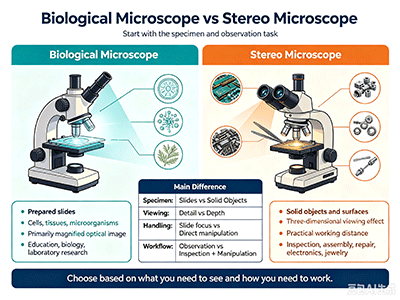
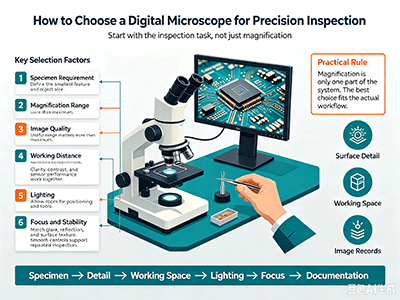
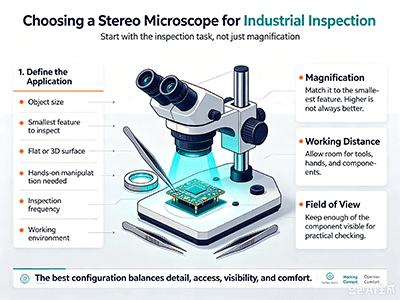
A Biological Microscope is an optical microscope designed primarily for observing biological specimens at relatively high magnification. It is commonly used with prepared slides because many biological samples contain structures that are too small to observe clearly with the unaided eye.
In a Biological Microscope, light passes through or interacts with the specimen and then travels through the optical system to produce an enlarged image. Objective lenses and eyepieces work together to provide different levels of magnification. The user can change magnification according to the size and detail of the specimen.
A Biological Microscope is particularly useful when the main goal is to study internal structures rather than the overall external shape of an object. Cells, tissues, microorganisms, plant sections, and prepared biological samples are typical examples.
Because biological observation often requires careful focusing and stable illumination, the mechanical and optical design of a Biological Microscope is important. Smooth focusing, stable specimen positioning, suitable illumination, and clear optical components all contribute to a practical observation experience.
A Stereo Microscope is designed for observing objects with greater depth perception. Instead of focusing primarily on thin prepared slides, a Stereo Microscope is commonly used to examine solid objects, surfaces, components, assemblies, and specimens that can be handled directly during observation.
The optical arrangement of a Stereo Microscope allows the observer to view an object from slightly different optical paths. This produces a three-dimensional or stereoscopic viewing effect. As a result, the shape, height, surface structure, and spatial relationship of different parts can be easier to understand.
A Stereo Microscope is useful when the operator needs to manipulate the specimen while observing it. This makes the Stereo Microscope suitable for inspection, assembly, repair, teaching, jewelry work, electronics observation, and other applications involving relatively larger objects.
Another important feature of a Stereo Microscope is working distance. The space between the objective area and the specimen allows the user to position tools or hands around the object. This practical working space can be important during detailed inspection or manual work.
The main difference between a Biological Microscope and a Stereo Microscope is the type of observation each instrument is designed to support.
| Feature | Biological Microscope | Stereo Microscope |
|---|---|---|
| Primary purpose | Biological specimen observation | Surface and three-dimensional object observation |
| Typical specimens | Cells, tissues, microorganisms, prepared slides | Components, assemblies, jewelry, small objects |
| Viewing effect | Primarily magnified optical image | Three-dimensional viewing effect |
| Specimen preparation | Often requires prepared slides | Usually allows direct object observation |
| Working distance | Generally suited to slide-based observation | Generally provides more space around the specimen |
| Typical use | Education, biology, Laboratory Research | Inspection, assembly, jewelry, electronics |
This comparison does not mean that one microscope can replace the other in every situation. The correct choice depends on the observation task. A Biological Microscope is more appropriate when microscopic biological structures need to be examined, while a Stereo Microscope is more practical when the user needs to inspect the surface and three-dimensional structure of a physical object.
One of the most common uses of a Biological Microscope is cell observation. Cells contain structures that are too small to examine effectively with the naked eye. A Biological Microscope provides optical magnification that allows users to observe prepared biological samples in greater detail.
In educational environments, a Biological Microscope can be used to demonstrate basic cell structures and biological concepts. Students can observe prepared slides and learn how biological structures appear at different magnification levels.
In laboratory environments, a Biological Microscope can support routine specimen observation and research activities. Depending on the sample and application, users may examine tissues, microorganisms, plant sections, or other prepared specimens.
The quality of the optical system is important because biological samples often contain fine details. Clear objective lenses, suitable illumination, stable focusing, and accurate specimen positioning all contribute to useful observation.
A Stereo Microscope is particularly useful when the object itself needs to be handled, rotated, inspected, or manipulated during observation. Instead of placing the sample on a prepared slide, the operator can usually position the object directly under the optical system.
For example, a Stereo Microscope can be used to examine small mechanical components, electronic parts, jewelry, gemstones, connectors, molded parts, and other objects where surface details matter.
The three-dimensional viewing effect is another reason users choose a Stereo Microscope. When an object has height, depth, edges, grooves, holes, or multiple surfaces, stereoscopic observation can make its physical structure easier to understand.
The working distance also matters. During inspection or manual operations, the operator may need to use tweezers, small tools, or other equipment. A suitable Stereo Microscope provides enough space to work around the specimen without making the observation process unnecessarily difficult.
Magnification is an important consideration when comparing a Biological Microscope with a Stereo Microscope. However, higher magnification is not automatically better. The useful magnification depends on the size and type of detail that needs to be observed.
A Biological Microscope is generally selected when the user needs to examine very small biological structures. The combination of objective lenses, eyepieces, illumination, and specimen preparation determines how much useful detail can be observed.
A Stereo Microscope is generally used at magnification levels suitable for inspecting physical objects and surfaces. The operator often needs a balance between magnification, field of view, working distance, and ease of handling.
When choosing a microscope, it is better to ask what detail must be visible rather than simply asking for the highest possible magnification. Excessive magnification can reduce the field of view and make handling more difficult.
Working distance is the space between the objective area and the specimen during observation. It is especially important when comparing a Biological Microscope and a Stereo Microscope because their typical working environments are different.
A Biological Microscope Used for slide observation generally does not require the same physical workspace around the specimen. The slide is positioned on the stage, and the user focuses the optical system on the sample.
A Stereo Microscope often needs more room around the object because the operator may need to move, rotate, inspect, or manipulate the specimen. When the application involves manual assembly or repair, working distance becomes an important practical factor.
For Industrial Inspection, users should consider the size of the object and whether tools need to be placed underneath the microscope. For jewelry work, for example, comfortable handling space can be just as important as magnification.
Specimen preparation is another major difference between a Biological Microscope and a Stereo Microscope.
A Biological Microscope commonly works with prepared slides. Biological material may need to be cut, mounted, stained, or otherwise prepared before observation. The preparation method depends on the type of sample and the purpose of the observation.
A Stereo Microscope usually allows direct observation of solid objects. A component, piece of jewelry, small assembly, or other physical object can often be placed directly beneath the optical system.
This difference affects workflow. If the application involves repeated inspection of manufactured components, a Stereo Microscope may provide a more practical working process because the operator can inspect the object directly. If the application involves prepared biological specimens, a Biological Microscope is designed around that type of observation.
A Biological Microscope and a Stereo Microscope also differ in how the user perceives the specimen.
A Biological Microscope is designed to provide a highly magnified view of microscopic structures. When observing a prepared slide, the main objective is usually to see fine details clearly and distinguish structures within the specimen.
A Stereo Microscope provides a stereoscopic viewing effect that helps the user understand the shape and depth of a physical object. This is useful when surface geometry matters.
For example, when inspecting a small mechanical component, it may be important to determine whether an edge is raised, recessed, curved, or damaged. A Stereo Microscope can make this type of physical structure easier to examine.
Lighting plays an important role in both a Biological Microscope and a Stereo Microscope, but the lighting approach depends on the specimen.
Biological observation often requires illumination that makes structures inside or on a prepared specimen visible. The lighting system must work together with the optical system and specimen preparation method.
For a Stereo Microscope, illumination may focus on the surface of an object. Different surface textures, colors, reflective areas, and recessed structures may require different lighting arrangements.
When selecting a microscope, users should consider the material being observed and the visual information that needs to be identified. A microscope with suitable optical performance can still produce poor observation results if the lighting is not appropriate for the specimen.
Both a Biological Microscope and a Stereo Microscope can be useful in education, but they support different types of learning.
A Biological Microscope is suitable for biology lessons involving cells, tissues, microorganisms, plant structures, and prepared slides. Students can learn how microscopic structures appear at different magnification levels.
A Stereo Microscope is useful when students need to observe physical objects, materials, insects, plants, small components, or three-dimensional structures. Because objects can often be observed directly, the Stereo Microscope can support hands-on learning.
The choice therefore depends on the subject being taught. Biology laboratories may require a Biological Microscope, while science education programs involving physical objects and surface structures may benefit from a Stereo Microscope.
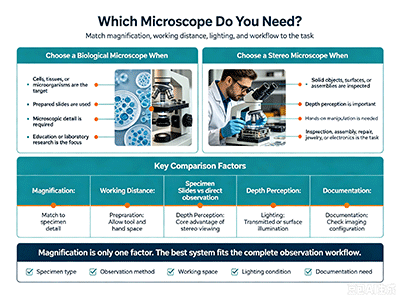
Laboratory requirements vary widely. A laboratory focused on biological specimens will generally have different microscope requirements from a laboratory performing material or component inspection.
A Biological Microscope is commonly associated with biological research, specimen observation, education, and routine laboratory work. Its optical configuration is designed around microscopic specimen observation.
A Stereo Microscope is commonly associated with inspection and manipulation of larger objects. It can support observation of components, assemblies, materials, jewelry, and other physical samples.
Before purchasing either type, the laboratory should identify the actual workflow. Consider what specimens are observed, how samples are prepared, how much magnification is required, whether the object must be manipulated, and whether images need to be documented.
Jewelry inspection generally requires a different approach from biological observation. Jewelry pieces contain surfaces, edges, stones, settings, joints, and small structural details that need to be examined from different angles.
A Stereo Microscope can be useful for this type of work because it allows three-dimensional observation and provides practical space for handling small objects.
A Biological Microscope is normally not the first choice for routine jewelry inspection because its primary purpose is microscopic specimen observation rather than direct examination of three-dimensional objects.
For jewelry-related work, users should consider magnification, working distance, lighting, viewing comfort, object positioning, and the type of surface details that need to be inspected.
Industrial inspection can include many different tasks, so the choice between a Biological Microscope and a Stereo Microscope depends on the inspection target.
If the inspection involves solid components, small assemblies, surface defects, connectors, molded parts, or mechanical details, a Stereo Microscope may fit the workflow because the operator can observe the object directly and work around it.
If the application involves biological materials or prepared microscopic specimens, a Biological Microscope is more suitable.
In either case, users should define the inspection task before selecting equipment. A useful checklist includes specimen size, smallest detail, required magnification, working distance, lighting conditions, focusing method, observation time, and whether documentation is required.
Both Biological Microscope and Stereo Microscope systems can be configured around different viewing requirements. Binocular observation allows the user to view through two optical paths, which can be comfortable during extended observation.
Trinocular configurations can be useful when observation and image documentation are required at the same time. A camera can be integrated into the optical system where the microscope configuration supports digital imaging.
The choice between binocular and trinocular observation depends on the workflow. If the microscope is primarily used for direct visual observation, binocular viewing may be sufficient. If images need to be captured, shared, or recorded, a configuration supporting imaging can be considered.
The easiest way to choose between a Biological Microscope and a Stereo Microscope is to start with the specimen.
If you mainly observe cells, tissues, microorganisms, or prepared slides, consider a Biological Microscope.
If you mainly observe solid objects, surfaces, components, or assemblies, consider a Stereo Microscope.
If three-dimensional observation is important, consider a Stereo Microscope.
If microscopic biological structures are the main target, consider a Biological Microscope.
If the operator needs to manipulate the object while observing it, consider the working distance of a Stereo Microscope.
If image documentation is important, check whether the selected microscope configuration supports suitable imaging equipment.
This approach is more practical than choosing equipment based only on magnification. The microscope should match the actual observation process.
One common mistake is focusing only on magnification. A higher magnification does not automatically provide a better observation experience. Field of view, optical clarity, illumination, focusing, and working distance also affect the final result.
Another mistake is selecting a microscope without considering specimen size. A microscope designed around prepared slides may not be convenient for large or irregular objects.
Users may also overlook operator comfort. If a microscope is used for several hours each day, stable focusing, comfortable viewing, convenient specimen positioning, and practical controls can make a significant difference.
Another common issue is failing to consider future applications. A laboratory may initially need basic observation but later require image documentation, teaching demonstrations, or more detailed inspection. It is useful to consider the expected workflow before finalizing the configuration.
Regular maintenance helps preserve microscope performance. Optical surfaces should be handled carefully and cleaned with suitable materials. Dust should be controlled because contamination can affect image quality.
Mechanical components should also be kept in good condition. Focusing mechanisms, stages, knobs, and other moving parts should operate smoothly. When abnormal resistance or movement appears, the equipment should be checked rather than forced.
Proper storage is equally important. A microscope should be protected from dust, moisture, unnecessary vibration, and accidental impact. Following the manufacturer's maintenance instructions can help extend service life and maintain consistent observation quality.
There is no universal microscope configuration that suits every observation task. The right choice depends on the relationship between the specimen, optical requirements, working distance, lighting, magnification, and workflow.
A Biological Microscope is centered on microscopic biological observation. It is well suited to cells, tissues, microorganisms, prepared slides, education, and laboratory research.
A Stereo Microscope is centered on three-dimensional observation of physical objects. It is useful for surfaces, components, assemblies, jewelry, Small Parts, and inspection tasks where object handling and depth perception matter.
Understanding this distinction can prevent unnecessary purchases and help users create a more efficient observation workflow.
When comparing a Biological Microscope and a Stereo Microscope, the most important question is not simply which microscope has greater magnification. The better question is what you need to see and how you need to work with the specimen.
Choose a Biological Microscope when your work centers on cells, tissues, microorganisms, prepared slides, biological research, education, or laboratory specimen observation. Its optical design is intended to reveal microscopic structures that cannot be examined effectively with the naked eye.
Choose a Stereo Microscope when your work centers on solid objects, surfaces, components, assemblies, jewelry, or other three-dimensional specimens. Its stereoscopic viewing effect and practical working distance make it suitable for detailed physical inspection and hands-on observation.
For schools, universities, laboratories, inspection departments, and manufacturers, the right microscope should be selected according to the actual application rather than a simple magnification number. By evaluating specimen type, observation method, working distance, illumination, optical clarity, focusing, and documentation requirements, users can identify a microscope configuration that matches their daily work.
The key difference between a Biological Microscope and a Stereo Microscope is therefore the observation task. A Biological Microscope focuses on microscopic biological structures, while a Stereo Microscope focuses on three-dimensional objects and surfaces. Once the specimen and workflow are clearly defined, choosing between the two becomes much more straightforward.
Add: No.70 Zhenxing East Road, Zhangshui Town,Haishu District,Ningbo City,Zhejiang,China
Contact Person: Mr. Xu Contact Number:+86 13777211956
Tel:+86 574-88152588/574-88152566
Fax:+86 574-88152570
Post Code:315161
E-mail:chinahg@hgopt.com

This website uses cookies to ensure you get the best experience on our website.
 中文
中文


 WhatsApp
 Phone
Phone E-mail
 Message
Comment
(0)